The dartboard is at the heart of every game of darts. Depending on the game system, traditional sisal dartboards for steel-tip darts or electronic dartboards for soft-tip darts are used. In addition to the material and construction, dimensions, height, throwing distance and segment layout are particularly important.
In this guide, you will learn how a dartboard is constructed, how the individual areas are scored and how different types of dartboards differ from one another.
The History of the Dartboard
The development of the modern dartboard cannot be attributed to a single person. Darts evolved over time from various forms of target and throwing games, particularly in Great Britain.
Early dartboards were made from materials including wood. These required regular maintenance because the impact of the darts could leave permanent marks.
During the 20th century, sisal fibres eventually became established as the material of choice for high-quality traditional dartboards. The fibres can partially close up again after a dart hits them, allowing a sisal board to remain playable for a long time when properly maintained.
At the same time, electronic dartboards were developed for soft-tip darts. These are made of plastic and detect hits through openings in the segments. On many machines, the scores are automatically recorded electronically.
How Is a Traditional Dartboard Constructed?
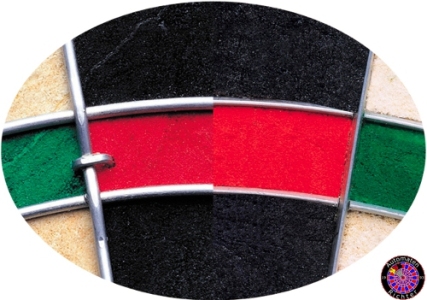
A traditional steel-tip dartboard essentially consists of a round sisal body divided into 20 numbered segments. The individual areas are separated by what is known as the spider.
On high-quality dartboards, these separators are made from very thin wire or a similarly designed thin metal profile. A slim spider can reduce the likelihood of bounce-outs caused by the separators.
The numbers on a dartboard can also be designed in different ways. Raised metal number rings are commonly used, while on other boards the numbers are printed directly onto the board.
A traditional tournament dartboard has an outer diameter of approximately 45.1 cm (17.75 inches) and is divided into 20 segments.
Dartboard Height and Throwing Distance
For traditional steel-tip darts, the dartboard is mounted so that the centre of the bullseye is 1.73 m above the floor. The horizontal distance from the front of the board to the throwing line, known as the oche, is 2.37 m.
|
Measurement |
Steel-tip darts |
Soft-tip darts |
|
Bullseye height |
1.73 m |
depending on the rules or machine |
|
Throwing distance |
2.37 m |
frequently 2.44 m |
|
Board |
Sisal / Bristle |
electronic plastic board |
|
Dart point |
Steel Point |
Soft Tip |
Important: With soft-tip darts and electronic dartboards, dimensions and setup rules may vary depending on the machine, governing body or game system. For a specific setup, always follow the applicable rules or the manufacturer's specifications.
Scoring on the Dartboard
The traditional dartboard consists of 20 numbered segments with values from 1 to 20. Each segment is further divided into single, double and treble scoring areas.
Single
The large area of a segment scores the printed value. For example, hitting the single 20 scores 20 points.
Double
The narrow outer ring doubles the value of the respective segment. The double 20 therefore scores 40 points.
Triple
The narrow inner ring triples the value of the segment. The triple 20 scores 60 points.
Bull
The outer bull area scores 25 points. The inner bull, or bullseye, scores 50 points.
Hits outside the scoring areas do not count. A dart that hits the board or a wire and then fails to remain in the board is also not scored in normal play.
Why Is the Spider Important on a Dartboard?
The spider refers to the separators between the individual scoring areas. Older dartboards may use relatively wide wires for this purpose. Modern high-quality boards often feature particularly thin or closely fitted wire constructions.
The less space the separators occupy, the more target area remains available to the player. Thin separators can also help reduce the number of bounce-outs caused by the spider.
When comparing dartboards, it is therefore worth looking not only at the sisal but also at the spider construction and the way the numbers are attached.
The Maximum Score: 180
The highest score that can be achieved with three darts in a single visit is 180 points. To achieve this, all three darts must hit the triple 20.
The triple 20 is therefore one of the best-known targets in darts and plays an especially important role in games such as 501.
What Types of Dartboards Are Available?
In addition to the traditional tournament dartboard, there are various designs and specialised versions.
|
Dartboard Type |
Typical Use |
Features |
|
Bristle Dartboard |
Steel-tip darts |
Sisal fibres, steel points, traditional segment layout |
|
Electronic Dartboard |
Soft-tip darts / E-Darts |
Plastic segments, scoring holes and automatic score tracking |
|
American Dartboard |
Certain American game variants |
Different segment and bull layout |
|
Quadro Board |
Specialised game variants |
Additional quadruple ring |
|
Training Board |
Training |
Different double and treble areas or specialised target areas depending on the model |
Bristle Dartboard or Electronic Dartboard?
Bristle Dartboard for Steel-Tip Darts
The traditional sisal board is played with darts featuring metal points. It follows the classic construction of steel-tip darts and is suitable for both training and competition.
View Bristle Dartboards
Electronic Dartboard for Soft-Tip Darts
Electronic boards are made of plastic and are played with darts featuring plastic tips. Hits are detected through the segment openings and automatically counted on many machines.
View Electronic Dart Machines
What Should You Look for When Buying a Dartboard?
-
Game system: First decide whether you want to play steel-tip darts or soft-tip darts.
-
Material: For traditional boards, high-quality sisal is an important component.
-
Spider: A slim construction can increase the target area and reduce bounce-outs.
-
Build quality: Look for an even surface and clean, consistent segment construction.
-
Number ring: A removable number ring can make it easier to rotate the board, allowing for more even wear.
-
Mounting: A secure mounting system is important to ensure that the board remains safely in place and does not move unnecessarily during play.
-
Lighting: Even lighting with as few shadows as possible improves visibility across the entire board.
The right dartboard provides the foundation for effective training and long-lasting enjoyment of the game. For steel-tip darts, high-quality sisal boards are the traditional choice, while soft-tip players use electronic dartboards. The key factors are the game system, build quality and features of the particular board.

 Information
 Customer Service
 Extras
 Account